School Timings: 9.00 AM - 2.00 PM


Textbooks and tests are no longer the exclusive components of education today. Beyond the classroom, children acquire skills, values, and attitudes that will influence their future in addition to information. This is true learning. The educational concept at Hera Public School is based on holistic development, which nurtures each child's mind, body, and character. The school makes sure that students are equipped to confront the world with compassion, creativity, and confidence by striking a balance between extracurricular activities and academics.
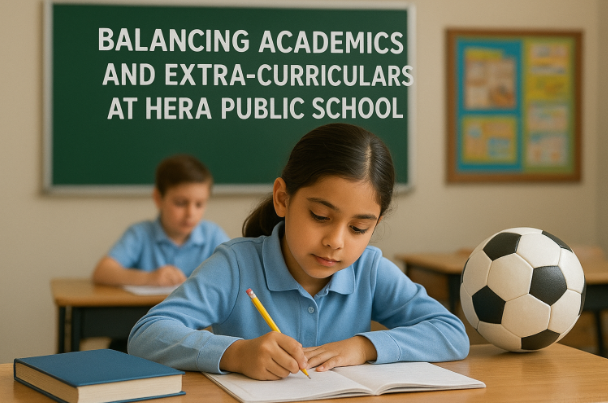
Holistic development means overall growth of a student—intellectual, emotional, physical, social, and moral. It is not just about achieving high marks; it is about cultivating life skills such as leadership, teamwork, problem-solving, and emotional intelligence. At Hera Public School, education is seen as a journey of discovery. The school combines a strong academic foundation with opportunities in sports, arts, cultural activities, technology, and community service. This balanced approach ensures that students are not only good learners but also well-rounded individuals.
In many traditional schools, there is often an imbalance where academics dominate and extra-curricular activities are seen as secondary. But research shows that students who participate in extra-curricular activities perform better academically and also develop critical life skills.
At Hera Public School, balance is the key:
Academics provide knowledge – essential for career building.
Extra-curriculars build skills – essential for life.
By maintaining this harmony, the school ensures that students are not pressured into rote learning but instead develop a love for knowledge while enjoying opportunities to express themselves.
Academics remain the backbone of Hera Public School’s vision. The curriculum is designed to be engaging, challenging, and aligned with national education standards.
Interactive Learning: Teachers use modern teaching aids, smart classes, and digital resources to make learning interactive and practical.
Personalized Attention: Small teacher-student ratios ensure that every child’s learning style is recognized.
Critical Thinking Focus: Rather than memorizing, students are encouraged to ask questions, think critically, and solve problems.
Examinations & Assessments: Assessments are not just about grades but about identifying strengths and areas for improvement.
The goal is to help students excel academically without being burdened, ensuring they have time and energy to participate in extra-curriculars.
Extra-curricular activities are not treated as optional at Hera Public School—they are an integral part of the curriculum. These activities provide a platform for students to showcase talent, discover interests, and build confidence.
Some of the key areas include:
Cricket, football, basketball, athletics, badminton, and yoga are part of the sports program.
Fitness training, regular PT sessions, and annual sports day foster a spirit of discipline and teamwork.
Participation in inter-school and state-level competitions gives students wider exposure.
Dance, drama, and music are encouraged as a way of creative expression.
Annual cultural fests allow students to present their artistic talents to a larger audience.
Drawing, painting, and craft workshops are organized to nurture creativity.
Students learn to express emotions and ideas visually, helping in personality development.
Debate clubs, science clubs, literature societies, and eco-clubs help students engage intellectually.
Participation in quizzes, competitions, and exhibitions sharpens their knowledge and communication skills.
Volunteering activities, cleanliness drives, and charity events encourage empathy and social responsibility.
Student councils and leadership programs develop decision-making and organizational skills.
Hera Public School has carefully structured its timetable so that neither academics nor extra-curriculars overshadow one another.
Activity Periods: Designated slots are given for sports, arts, and hobbies during the week.
Weekend Engagements: Clubs and competitions are often organized on weekends to ensure flexibility.
Integrated Learning: Subjects are sometimes taught through projects and creative methods that connect academics with activities.
For example, a science lesson on the environment may be connected with an eco-club project, or a history lesson may lead to a drama performance about freedom fighters.
Teachers at Hera Public School play the role of mentors. They identify the strengths of every child and guide them toward areas where they can shine.
Academic Mentors: Help students build strong foundations.
Sports Coaches: Provide rigorous training while ensuring enjoyment.
Activity Coordinators: Encourage students to explore creative fields.
By working as facilitators rather than just instructors, the teachers help students find their passion and pursue it alongside academics.
The impact of this balanced approach at Hera Public School can be seen in the way students grow:
Improved Academic Performance: Students involved in activities tend to perform better academically due to improved concentration and time management.
Confidence & Leadership: Participation in debates, sports, and stage activities builds public speaking and leadership skills.
Teamwork & Collaboration: Group activities foster cooperation and empathy.
Stress Management: Extra-curriculars provide relaxation and help students manage academic stress.
Career Opportunities: Talents discovered in school often open career paths in arts, sports, or social leadership.
Hera Public School takes pride in the following current and former pupils who have profited from this well-rounded education:
Students have competed in sports at the state level on behalf of the school.
Debate and quiz contest winners have brought honors to the school.
Numerous students have followed artistic, musical, and theatrical careers, demonstrating the influence of the school's support.
Hera Public School believes that parents are key partners in education. The school regularly conducts:
Parent-Teacher Meetings (PTMs): To discuss academic progress and extra-curricular involvement.
Workshops for Parents: Helping parents understand the importance of balance.
Cultural Events & Sports Days: Where parents are invited to witness and encourage their children’s achievements.
This involvement ensures that the balance created at school is also supported at home.
In today’s world, academic qualifications alone are not enough. Employers and universities look for individuals who have skills beyond books—creativity, teamwork, leadership, and resilience.
By balancing academics with extra-curriculars, Hera Public School prepares its students to:
Excel in higher education.
Adapt to diverse career paths.
Face challenges with confidence.
Contribute positively to society.
This is what makes Hera students stand out in the global landscape.
At Hera Public School, holistic development is a reality, not just a trendy term. By establishing the ideal balance between extracurricular activities and academics, the school guarantees that each kid develops into a self-assured, competent, and kind person.The goal of education at Hera Public School is to prepare students for life, not merely for tests. Students are always urged to explore, learn, and develop—whether in the classroom, on the field, on stage, or during community service.
