School Timings: 9.00 AM - 2.00 PM

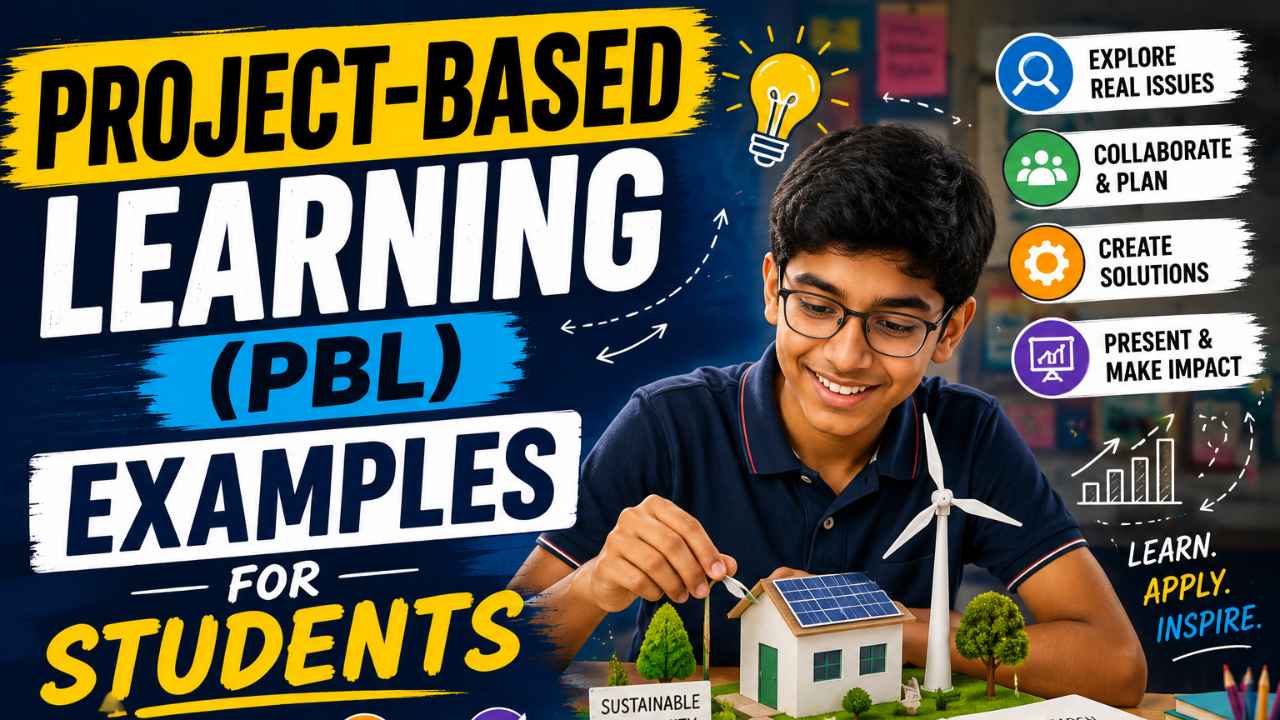
Project-Based Learning not only strengthens academic understanding but also helps students develop essential life skills such as critical thinking, collaboration, creativity, and communication. In this detailed blog, we will explore what PBL is, its importance, and a wide range of practical examples across different grade levels.

Project-Based Learning is a student-centered teaching approach in which students gain knowledge and skills by working on projects over an extended period. These projects are often based on real-life challenges or questions that require investigation, planning, and presentation.
Instead of passively receiving information, students actively participate in their learning process. They ask questions, conduct research, test ideas, and present their findings.
PBL encourages students to understand concepts rather than memorize them. By applying knowledge in practical situations, learning becomes more meaningful and long-lasting.
Students develop skills like teamwork, time management, leadership, and decision-making, which are essential for future success.
Projects often involve problem-solving, analysis, and evaluation, helping students think logically and independently.
Learning becomes more interesting when students work on hands-on projects instead of just reading textbooks.
Students are encouraged to explore innovative ideas and present their work in creative ways.
To make Project-Based Learning successful, certain elements should be included:
Real-world relevance: Projects should connect with real-life situations
Student voice and choice: Allow students to make decisions
Inquiry-based approach: Encourage questioning and exploration
Collaboration: Promote teamwork and group work
Reflection: Help students evaluate their learning
Presentation: Students should present their final outcomes
At this stage, projects should be simple, creative, and activity-based.
Students create a visual representation of their family members using charts, drawings, or digital tools. They can also present information about each member.
Learning Outcome: Improves communication skills and understanding of relationships.

Students plant seeds and observe their growth over days or weeks. They maintain a journal with drawings or notes.
Learning Outcome: Builds observation skills and basic scientific knowledge.
Students research roles like doctors, teachers, police officers, and present their importance in society.
Learning Outcome: Develops social awareness and respect for different professions.
Students create posters, slogans, and short speeches on water conservation.
Learning Outcome: Encourages environmental responsibility.
Students research an animal and present its habitat, food habits, and characteristics.
Learning Outcome: Enhances research and presentation skills.
Projects can become more structured and research-oriented at this level.
Students create a monthly budget for a household, including expenses and savings.
Learning Outcome: Teaches financial literacy and practical math skills.
Students research the history of their city or region and present it through charts or presentations.
Learning Outcome: Improves research and storytelling abilities.
Students build working or static models like volcanoes, solar systems, or water cycles.
Learning Outcome: Strengthens conceptual understanding through hands-on learning.
Students study waste segregation methods and create awareness campaigns in school or community.
Learning Outcome: Builds problem-solving skills and environmental awareness.
Students read a book and present its summary, characters, and message creatively.
Learning Outcome: Improves reading comprehension and communication.
At this stage, projects should focus on real-world challenges and advanced thinking.

Students design a business plan including product idea, pricing, marketing strategies, and target audience.
Learning Outcome: Develops entrepreneurial and strategic thinking.
Students create a short documentary on issues like pollution, education, or gender equality.
Learning Outcome: Enhances research, empathy, and digital skills.
Students build working models using solar or wind energy concepts.
Learning Outcome: Promotes innovation and STEM learning.
Students research different career options, required qualifications, and future scope.
Learning Outcome: Helps in career awareness and decision-making.
Students conduct surveys on topics like screen time or study habits and analyze data using graphs.
Learning Outcome: Strengthens analytical and mathematical skills.
These projects integrate multiple subjects and provide holistic learning:
Students grow plants or vegetables and learn about sustainability.
Subjects Covered: Science, environment, teamwork
Students create a magazine including articles, stories, artwork, and interviews.
Subjects Covered: English, art, creativity
Students explore traditions, festivals, and food of different cultures.
Subjects Covered: Social studies, art
Students create content on cyber safety and responsible internet use.
Subjects Covered: Technology, social awareness
Students participate in activities like cleanliness drives or donation campaigns.
Subjects Covered: Ethics, social responsibility
Start with a clear objective and problem statement
Provide guidance but allow independence
Use rubrics for assessment
Encourage group collaboration
Include regular feedback sessions
Allow students to present creatively
Parents play a vital role in encouraging project-based learning at home:
Provide necessary resources and materials
Encourage curiosity and questioning
Appreciate effort rather than just results
Help in time management
Avoid completing the project for the child
While PBL is highly effective, it may come with some challenges:
Time-consuming compared to traditional teaching
Requires proper planning and guidance
Assessment can be complex
Some students may struggle with teamwork
However, with proper strategies, these challenges can be managed effectively.
Project-Based Learning is a transformative approach that prepares students for real-world success. It shifts the focus from memorization to understanding, from passive learning to active exploration.
By integrating PBL into the education system, schools can create an engaging and meaningful learning environment where students not only gain knowledge but also develop essential life skills.
Encouraging students to learn through projects ensures they become confident, creative, and capable individuals ready to face future challenges.
